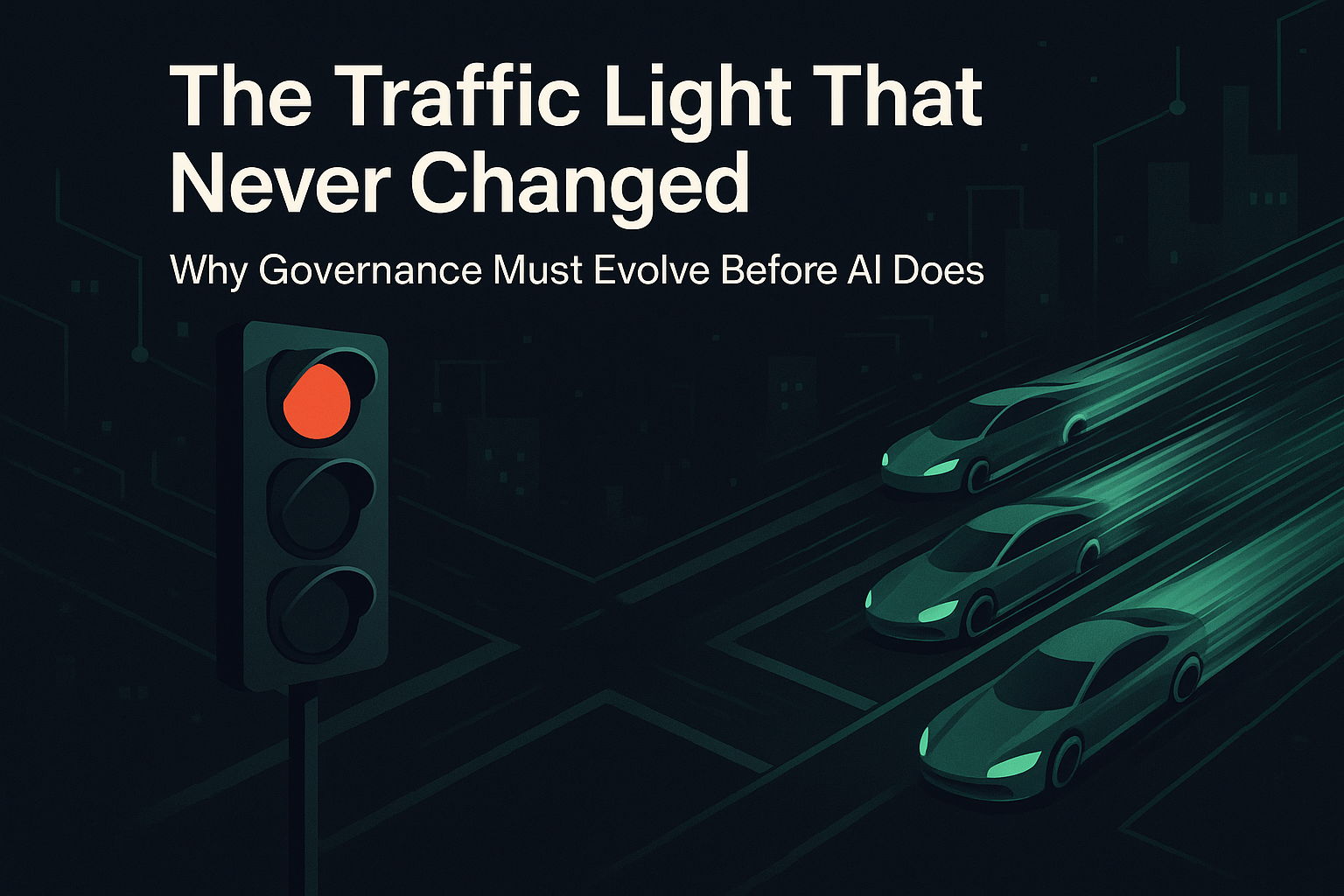
In most cities, traffic lights used to run on fixed timers. Green for 30 seconds, red for 45 — no matter what was happening on the road. Even if one side was empty and the other backed up with cars, the light never adapted. Drivers learned to simply wait, even when it made no sense. Over time, people stopped questioning the system — they just accepted the inefficiency as normal.
The Static Light
In the old world of access control, enterprises relied on IAM and RBAC — systems that behaved like traffic lights locked on fixed timers. Green for one role, red for another, with no awareness of what was actually happening on the “road.”
The results were predictable, if blunt. Finance got a green light to whole datasets. HR got a green light to entire record groups. Marketing got theirs too. It worked well enough when traffic was light — a few analysts running reports, databases that weren’t under constant pressure.
But the trade-offs were severe. Just like sitting at a red light on an empty street, users often waited or worked around the rules. And just like a green light that waves through traffic without checking, people often got far more access than they needed.
Over time, managing these static lights became its own discipline. Administrators layered on database views, custom filters, and brittle proxies to make the system safer. Whole projects spun up just to keep traffic flowing. Yet the core limitation remained: the lights never adapted.
Enter High-Speed Traffic
Now imagine the roads suddenly fill with self-driving cars, and high-speed vehicles moving 1000x faster than before. That’s what AI looks like inside the enterprise. Instead of a handful of commuters waiting patiently at red lights, you now have swarms of automated drivers hitting every intersection at once.
So what? How has the world changed?
The point at which the old traffic system fails is pushed way forward. Way, way forward.
Static lights that once worked fine for morning rush hour now cause gridlock — or worse, collisions. One mistimed green can let sensitive traffic flow straight into the wrong lane. The roads are ready for high speed, but the signals were never designed for it.
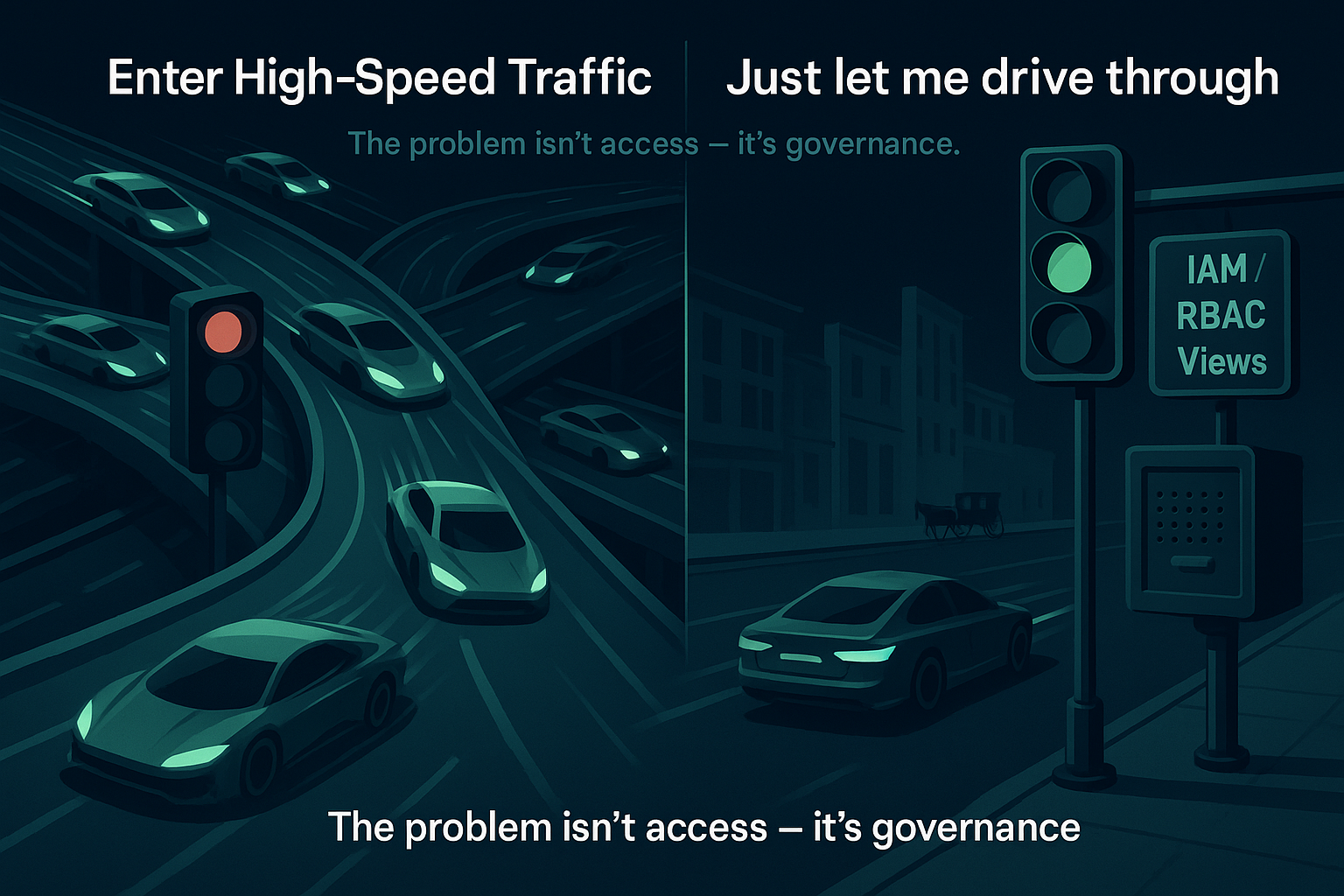
Just let me drive through
But an interesting thing happened — enterprises are back to trying to bolt AI directly onto databases.
Why? Because 95% of the old access stack — RBAC roles, IAM groups, static database views — was designed to control human access, not machines. That stack made sense when analysts wrote SQL queries at human speed. But with AI apps and agents generating queries in real time, those controls just don’t hold.
It’s like traffic lights designed for horse-drawn carriages — suddenly faced with self-driving cars moving 1000x faster. Instead of waiting for a manual approval, the queries just floor it straight through.
The problem isn’t access anymore. It’s whether that access is governed.
Let my queries go
AI makes it easy for anyone in the enterprise to touch data. It’s no longer just analysts with SQL skills — now copilots, agents, and everyday employees can query sensitive systems at the push of a button.
The problem isn’t raw horsepower anymore. Databases can scale. AI apps can generate the queries. The marathon of access is basically over.
But the last mile is missing: governance. Who decides which queries should pass, which should be masked, and which should stop? Without that control, enterprises are stuck. The cars can move, the lights are green — but the rules of the road haven’t been written.
So what’s next?
We don’t just need better access control — we need a completely new model for governing AI’s interaction with enterprise data.
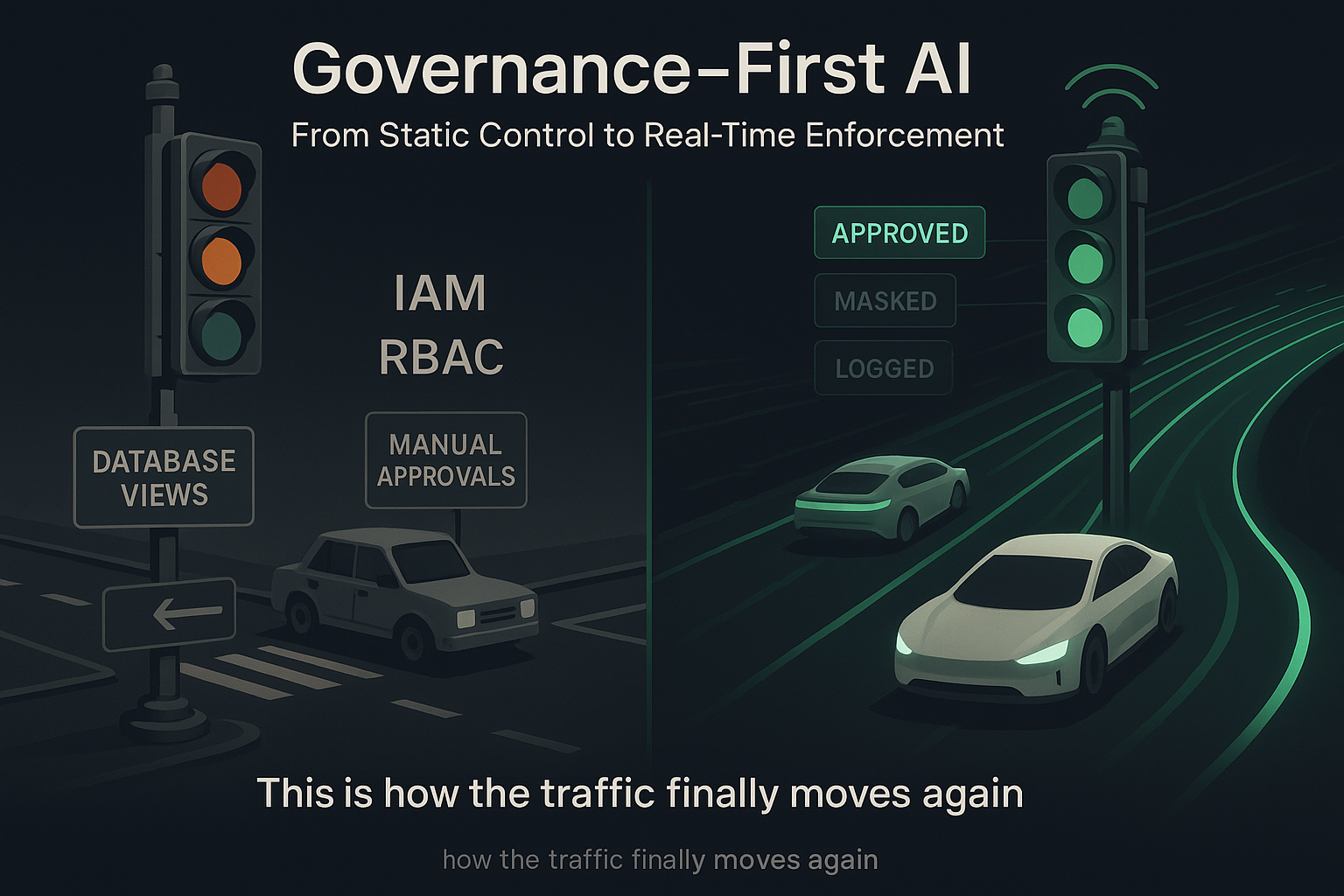
The old systems were built for a world where humans logged in occasionally and ran reports at human speed. To make that work, organizations stacked on IAM roles, database views, and manual approvals — the equivalent of hard-coded traffic lights with no sensors and no adaptation.
LLMac isn’t a bolt-on or a patch — it’s designed for the new traffic system. Instead of standing up more gates and checkpoints, we govern at query time, at the data layer, with full audit and enforcement built in. Policies aren’t baked into roles or buried in infrastructure. They’re dynamic, explainable, and enforced as the request happens.
This isn’t about restricting AI — it’s about making it safe to use everywhere it matters. When access is enforced in real time and every interaction is traceable, enterprises don’t have to choose between adoption and accountability.
That’s the shift:
We call it Governance-First AI — and it’s how the traffic finally moves again.